
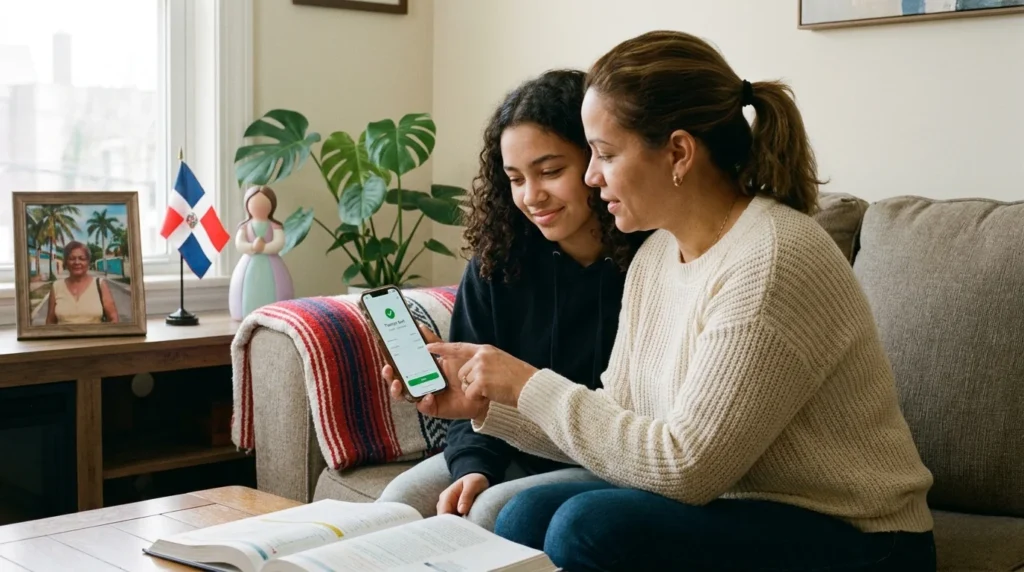
The Caribe Express receipt folded in your wallet, the screenshot of the BanReservas confirmation on your phone, the $250 you sent on Tuesday so your mami could pay the colmado on Wednesday: these are not transactions. They are a thread. And that thread is what holds together the 2.5 million people of Dominican origin living in the United States, who in 2025 alone moved close to $10 billion home. According to Banco Central de la República Dominicana, total dominican diaspora remittances reached $11.87 billion in 2025, growing 10.3% in a year when most other Latin American corridors flatlined or fell.
Sending money to the Dominican Republic is one of the most reliable acts of long-distance love in the Caribbean. And yet, almost no one talks about what it really means. This is that conversation.
The Number Behind Dominican Diaspora Remittances
$11.87 billion is a difficult figure to picture. It is roughly 9% of the entire Dominican GDP. It is more than the country earned from gold exports in 2024. It is three times more dependent on diaspora than Mexico’s economy, where remittances represent only 3.4% of GDP. And it arrived in the Dominican Republic the way it always arrives: in pieces. In tens of millions of separate transactions. In an average transfer of around $200 to $300. In WhatsApp voice notes that say “ya te llegó, mami” sent at 9 p.m. from a kitchen in Washington Heights, an Uber pickup line in Boston, a hospital break room in Lawrence, Massachusetts.
Roughly 84% of dominican diaspora remittances came from the United States in 2025. The largest concentration of senders lives in a strip that runs from Washington Heights and the Bronx in New York, through Paterson and Union City in New Jersey, into Lawrence and Lynn in Massachusetts, and down to East Orlando in Florida. Two Dominican provinces receive the bulk of what gets sent: the Distrito Nacional including Santo Domingo (about 48% of all flows) and Santiago de los Caballeros (about 11%). These are the same provinces that began sending workers north in the 1960s after Trujillo’s regime fell and the migration corridor to New York opened. Three generations later, the financial bridge those workers built is still standing, and now it is digital, instant, and increasingly account-to-account.
The Math of the Person Who Sends
The most accurate portrait of someone sending money to the Dominican Republic is not a generic “immigrant.” It is a 36-year-old woman who has lived in the United States for 12 years. She works as a home health aide in Lawrence, Massachusetts, with a second job cleaning offices on Saturday mornings. She has a U.S.-born son in second grade, and a mother in San Francisco de Macorís who is raising her younger niece. She speaks English at work and Dominican Spanish at home, fast and full of words like concho, vaina, cuartos. She files taxes every April. She has not seen her mother in person since 2019.
Her math is not the math the news talks about. Rent in a two-bedroom in Lawrence ($1,650), utilities, groceries, her son’s after-school program, her phone and gas, the credit card she keeps current because her credit score is the only formal financial document she has built in this country. And then, before anything for herself, $250 to the Dominican Republic. She is not “sending half her paycheck home.” She is running a household on two countries with a single budget. The remittance is structural.
And it is not always the same person every time. In Dominican-American families, the role of la que manda los cuartos rotates. The tía in the Bronx sends in May, before Mother’s Day. The cousin in Paterson sends in August, when classes start. The brother in Lawrence sends in December, when the regalía pascual bonus has to stretch and there is a quinceañero coming. This is not random; it is choreography. It is the unspoken family agreement that no one will be the only one carrying the weight, and no month will go by without something arriving.
What “Mandar Cuartos a Casa” Actually Means
There is a specific phrase in Dominican Spanish that does not translate cleanly: mandar cuartos a casa. The word cuartos is Dominican slang for money, older than dollars, older than pesos, a holdover from the colonial reales when a quarter of a real was the smallest unit of useful currency. The closest English equivalent is sending money to the Dominican Republic, but the Dominican phrase is heavier. The word casa is doing a lot of work there. It means the physical house your mother lives in, yes. But it also means the version of you that still lives there: the daughter who left at 22, the son who promised he would come back in two years, the cousin who said the next visit would be at Navidad. Casa is the version of yourself you mailed back, payment by payment, while you stayed up here building a different life.
This is why the moment of sending is rarely just a transaction. It is the small ritual of opening the app while the asopao is on the stove, sending the screenshot to your hermana, calling your mami 20 minutes later to make sure it landed, hearing her voice say “ya está, mija, gracias mi amor.” That sequence happens millions of times a year. It is the most-repeated act of love in the Dominican diaspora, and almost no economist has ever measured it.
The Calendar of the Dominican Diaspora
The dominican diaspora remittances year has a rhythm. Anyone who has worked in money transfer at Caribe Express, Quisqueyana, or Western Union can recite it from memory.
January 6. Día de los Reyes Magos. In the Dominican Republic, the Three Kings still bring the most important children’s gifts of the year, more than Santa Claus does in many homes. The transfers in late December and the first days of January are often $50 to $100 above what a sender normally moves. That is the bicycle, the doll, the soccer cleats, the Bluetooth speaker: the things the sender wants their nieces and nephews to have without their mother having to choose between the gift and the light bill.
February. Carnaval and Independencia. Carnaval La Vega runs every Sunday in February, and February 27 is Independence Day, the most important national holiday. Many senders schedule extra transfers to cover costumes for the kids, the family meal, and the music permits in the barrio. Carnaval is also when uncles fly back to march with their old comparsa. Sometimes the cost of that plane ticket has been quietly subsidized for months by remittances from a sister who is not flying with them.
Late May. The Mother’s Day surge. Día de las Madres in the Dominican Republic falls on the last Sunday of May (not the second Sunday, like in the U.S., a small detail every Dominican-American knows by heart). Flowers, cake, a Mass at the parish, a real meal with sancocho, sometimes a small piece of jewelry. The transfers in the week before are some of the most emotionally loaded of the year.
August. Back to school. The school year in the Dominican Republic starts in mid-August, and the cost of the uniform, the white school polo, the black shoes, and the mochila falls heavily on the abuelas raising grandchildren whose parents are abroad. The August spike is so consistent that money transfer operators in the corridor staff up for it every year.
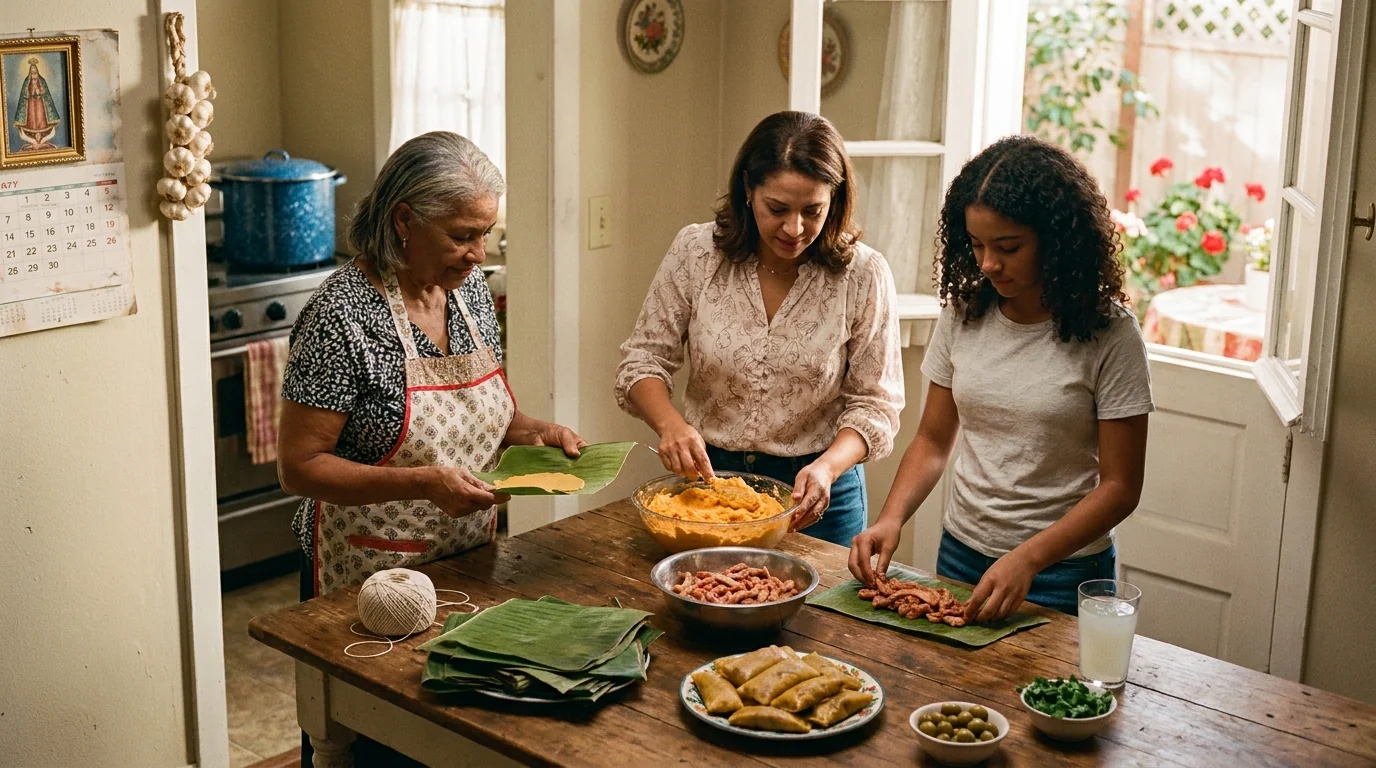
December. The biggest month. Navidad, Nochebuena, Año Nuevo, and the run-up to Reyes Magos. December remittances are roughly 15-20% above the annual average. Some of it is for gifts. Some is for the puerco asado, the pasteles en hoja, and the family meal that an entire household will share on Nochebuena. Some is for the bus ticket that brings a cousin from Santo Domingo back to the family pueblo in Bonao for one week. December is when the Dominican diaspora pretends, hard, that the distance between Lawrence and La Vega is smaller than it actually is.
And the rest of the year is the steady current beneath all of it: the rent for grandma’s casita in San Cristóbal, the cousin’s college fees at UASD or PUCMM, the medication bill from the local clínica, the new zinc roof after a tropical storm, the phone plan that lets the kid in Puerto Plata call his dad in Yonkers on a Wednesday for no reason.
2025 Was Mexico’s Hard Year. For the Dominican Republic, It Was Different.
2025 was a difficult year for most Latin American remittance corridors. Mexican remittances declined 4.6%, the first drop since 2009. Honduras and Guatemala saw single-digit growth. But dominican diaspora remittances moved in the opposite direction. Banco Central data showed a 10.3% increase, from $10.76 billion in 2024 to $11.87 billion in 2025, the largest single-year jump for the corridor in nearly a decade.
What explains the divergence? Three things working together. First, the Dominican-American workforce is concentrated in service, healthcare, and hospitality jobs that recovered faster from the 2024 slowdown than the construction and agricultural sectors that dominate the Mexican-American economy. Second, the Dominican peso devalued slightly against the dollar in 2025, which meant every dollar sent bought more pesos for the family, and senders responded by sending the same amount, not less. Third, and most importantly, the Dominican economy depends on diaspora flows at a structural level that Mexico’s does not. When 9% of your country’s GDP is funded from abroad, the diaspora knows it. The senders are not casual contributors; they are the country’s quiet financial backbone, and 2025 was the year that became visible.
The 1% Excise Tax: A New Variable in 2026
One thing changed in January 2026 that almost no one outside the industry noticed: the U.S. federal government began applying a 1% excise tax on cash-based remittances, as part of the OBBB Act. Cash transactions, money orders, and physical wire transfers from a corner store all carry an extra 1% on top of whatever fee the provider charges. Digital, account-funded transfers (debit, ACH, app-to-bank) are exempt.
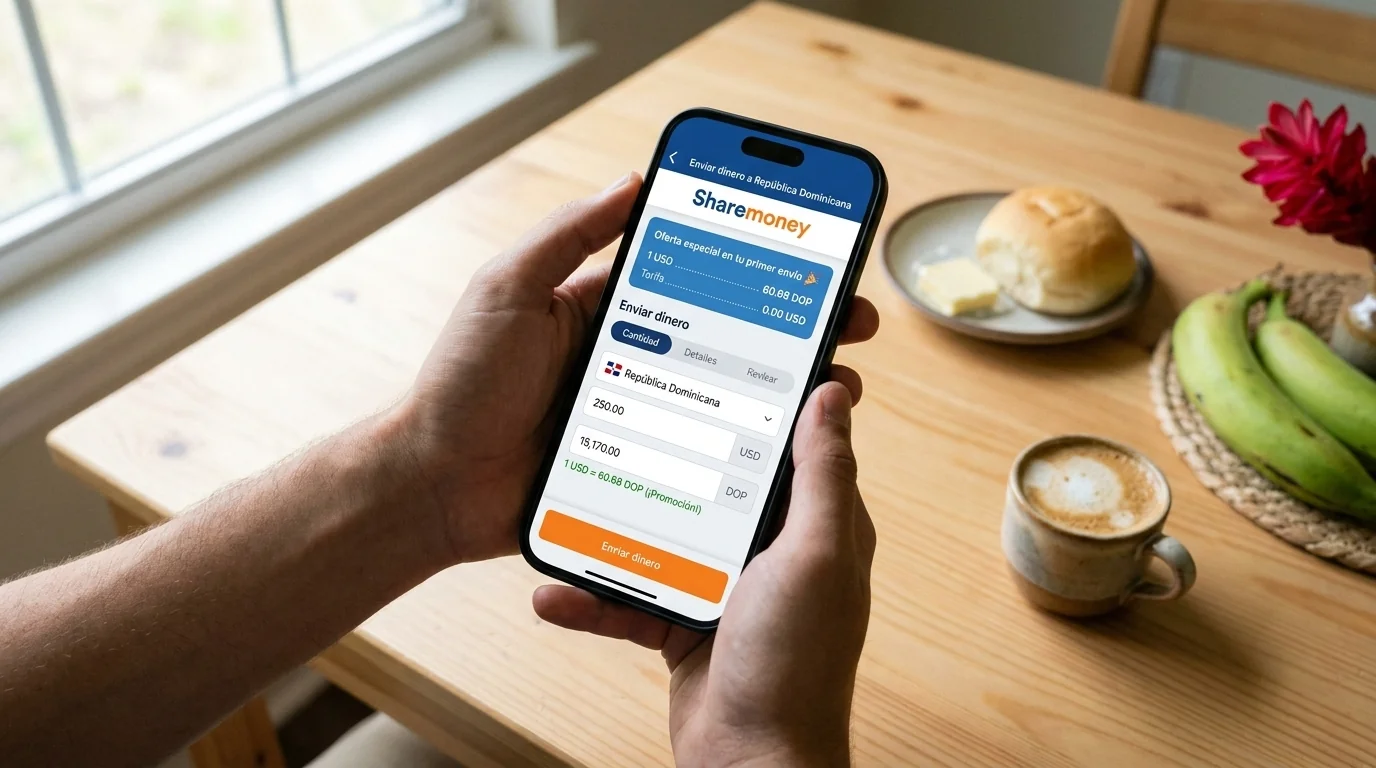
For a family sending $250 a month, that is an extra $30 a year if they send via cash, and $0 if they send digitally. Multiply that by tens of millions of Dominican-corridor transactions and the math gets serious. The tax is, in practice, a quiet policy push toward digital transfers, and the diaspora has noticed. Apps that connect a U.S. bank account to a Dominican beneficiary, like ShareMoney, have grown precisely because they are exempt from the tax and because the exchange rate they offer is closer to the interbank rate than what cash agents typically post on the wall in a Caribe Express location.
Where Dominican Diaspora Remittances Actually Go
When economists ask what remittances are spent on, they get one answer. When the receiving Dominican families are asked the same question, they give a different one. The economist’s answer is consumption smoothing and investment in human capital. The family answer is concrete: the medicine for grandma’s diabetes, the niño’s school uniform, the down payment on the cement house that replaced the wood-and-zinc one, the funeral for the tío who died too young, the wedding of the prima who fell in love with someone from El Seibo. Sending money to the Dominican Republic is not a single act with a single purpose; it is a thousand small obligations met one transfer at a time.
And then there is the part that no statistic captures: the colmado that opened because three siblings each sent $150 a month for two years to seed it. The motoconcho that became a small fleet of two. The salón de belleza in San Francisco de Macorís that started in a kitchen and now employs three women. Roughly 70% of dominican diaspora remittances go into basic consumption (food, healthcare, education, housing improvements), but a meaningful share goes into productive investment: small commerce, agriculture in the Cibao, taxis, beauty salons, micro-construction. That is how a barrio in Santiago whose grandkids all live in Lawrence still has a functioning local economy.
The Bicultural Identity of Sending
For first-generation Dominican immigrants, sending is an extension of familismo: the deeply rooted Dominican value that family obligation is structural, not optional, and that the eldest sibling who made it to Nueva Yol carries a quiet responsibility for everyone behind them. For the second generation, sending often becomes more selective and more emotional: the U.S.-born daughter who sends $100 to her grandmother every birthday, even though the grandmother has never asked, even though her own mother insists it is unnecessary.
This is the Dominican-American identity in motion: the high school senior in Lawrence who has never lived in the Dominican Republic but knows exactly how much a libra of plátano costs at the colmado in his abuela’s barrio in Santiago, because his mother has been buying it remotely for fifteen years. The line cook in the Bronx who has memorized the closing time of the BanReservas branch in Higüey. The bachata-dancing nurse in Paterson who knows that wires sent before 4 p.m. on Friday will land in time for her sister’s birthday Saturday morning. These are people who have built a parallel economy of love and obligation across the Mona Passage, $250 at a time.
Why the App You Use Matters More Than You Think
The choice of how you send matters, because over a decade of $250 monthly transfers, the difference between a 1.5% spread and a 4% spread is hundreds of dollars a year. That is a quinceañero dress. That is a year of school uniforms for two kids. That is a roof.
If your priority is speed and your relative has a debit card or a BanReservas, Banco Popular, or Banco BHD account, a digital app that deposits directly into a Dominican bank account beats every cash service on price and arrival time. If your relative is in a smaller pueblo without a nearby bank branch, a service with a wide cash pickup network at Caribe Express, Quisqueyana, or Banco Popular agencies makes the difference between a 30-minute walk and a two-hour bus ride. Most senders end up using both: digital direct-deposit for the regular monthly transfer, cash pickup for the surprise birthday or the emergency.
You can read more about each option in our corridor guides: the complete guide to sending money to the Dominican Republic from the USA, the workflow for BanReservas account deposits, the convenience of Caribe Express cash pickup, the truth about USD to DOP exchange rates, and a comparison of the cheapest ways to send money to the Dominican Republic.
When it’s time to turn that connection into support, you can send money to your family in the Dominican Republic in just a few minutes with ShareMoney.
A Final Word for the People Who Send
Every year, on the last Sunday of May, an entire country wakes up to bouquets that arrived from another country. Every August, hundreds of thousands of school uniforms are bought in Santiago and Santo Domingo with money that crossed the Mona Passage the week before. Every December, three generations of one family eat puerco asado that exists because someone in Lawrence picked up an extra Saturday shift in November. This is the macroeconomic story of dominican diaspora remittances, and it is also the most personal story in the Caribbean.
If you are the person who sends, the work you do is not invisible. It is measured by the World Bank, tracked by Banco Central de la República Dominicana, studied by economists at FUNGLODE and CEMLA, and felt in roughly 1.4 million Dominican households every single month. But more importantly, it is felt by the specific person who picks up the phone when your transfer notification arrives. Sending money to the Dominican Republic is, in the end, the closest thing to crossing the Mona Passage yourself, repeated as often as your love demands.
Get the Real Value of Sending Money to the Dominican Republic with ShareMoney
Our exchange rate is closer to the interbank rate than what most cash agents post in their Caribe Express windows. Account-funded transfers are exempt from the 1% federal excise tax. Direct deposit to BanReservas, Banco Popular Dominicano, Banco BHD, Scotiabank, and most major Dominican banks lands in minutes. Cash pickup at thousands of Caribe Express, Quisqueyana, and Banco Popular agencies when your family needs it that way. The first transfer is free for new senders.
Related reading: How to Send Money to the Dominican Republic from the USA: 2026 Guide · Send Money to BanReservas from the USA · Caribe Express Dominican Republic