
If you live in the United States and your family is in the Dominican Republic, there is a high chance their bank account is at Banco de Reservas. BanReservas is the largest bank in the country, the bank of the Dominican State, and for millions of Dominican families it is simply called “el banco.” This guide explains how to send money to BanReservas from the USA in a few minutes, what to know about fees, exchange rates, and account types, and what to do if your family does not have a BanReservas account yet.
For a wider view of all the ways to move money to your family, you can also read our complete 2026 guide to sending money to the Dominican Republic from the USA.
How to Send Money to BanReservas from the USA in Five Minutes
With the ShareMoney app, the whole process happens from your phone. There is no agency to visit, no envelope to seal, and no waiting in line. Here is how it works step by step.
- Download the ShareMoney app from the App Store or Google Play and create your account in under a minute. You will need a US ID and a US address.
- Choose Dominican Republic as the destination and Bank Deposit as the delivery method.
- Select Banco de Reservas (BanReservas) from the list of supported banks.
- Enter your recipient’s full name as it appears on their cédula and their BanReservas account number. Most family accounts are cuentas de ahorros, but cuentas corrientes work the same way for receiving deposits.
- Enter the amount you want to send in US dollars. You will see the live exchange rate to Dominican pesos and the exact amount your family will receive, with no hidden fees added at the end.
- Pay with your debit card, credit card, bank account, or prepaid card. Confirm and send.
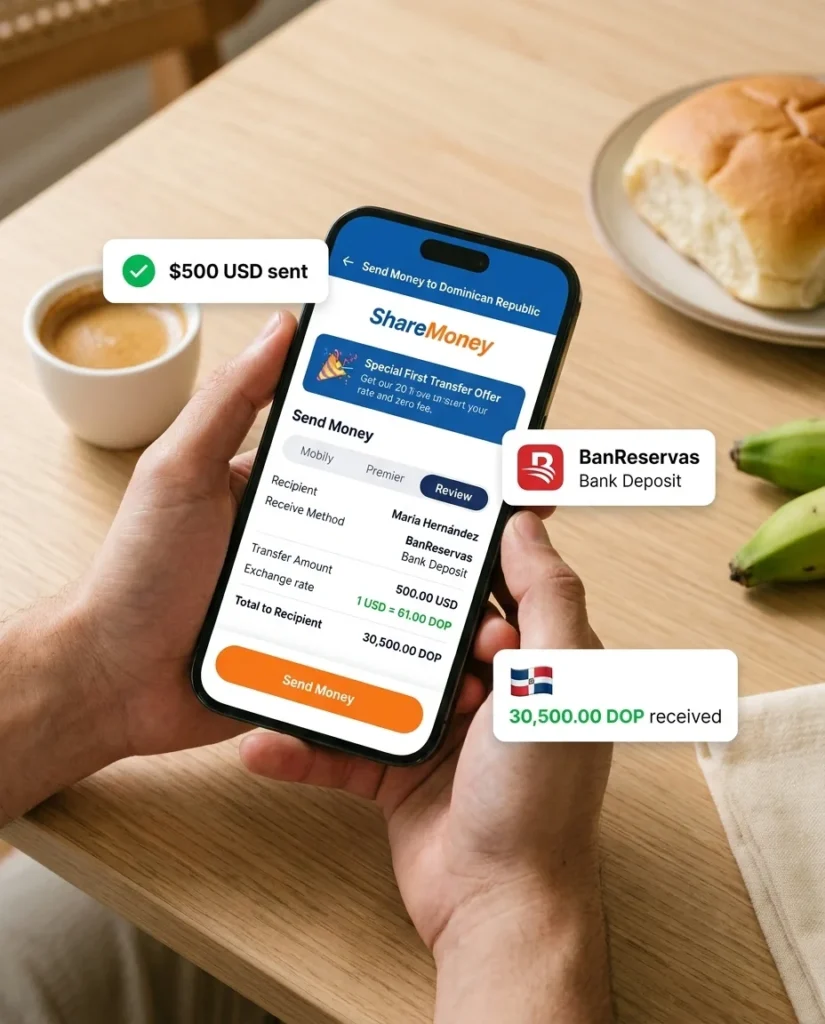
Your first three transfers with ShareMoney are free of the transfer fee, up to $500 each with a debit card. After that, fees are visible before you confirm. There are no surprises.
Why BanReservas Matters to Working-Class Dominican Families
To understand why this bank matters, it helps to know what BanReservas actually is. Founded in 1941 and headquartered in Santo Domingo, Banco de Reservas is the only commercial bank fully owned by the Dominican State. It is the largest bank in the country, with more than three million customers and a branch network of over three hundred sucursales spread from Santo Domingo and Santiago all the way to small cabeceras municipales in Bahoruco, Elías Piña, and Pedernales.
This is not the bank of executives in Piantini. It is the bank where your tía in San Francisco de Macorís goes to retrieve her pension. It is the bank where the colmadero in San Pedro deposits his weekly cash. It is the bank that opens accounts for public sector workers, teachers, and the millions of Dominicans whose first bank account ever was a BanReservas cuenta de ahorros.
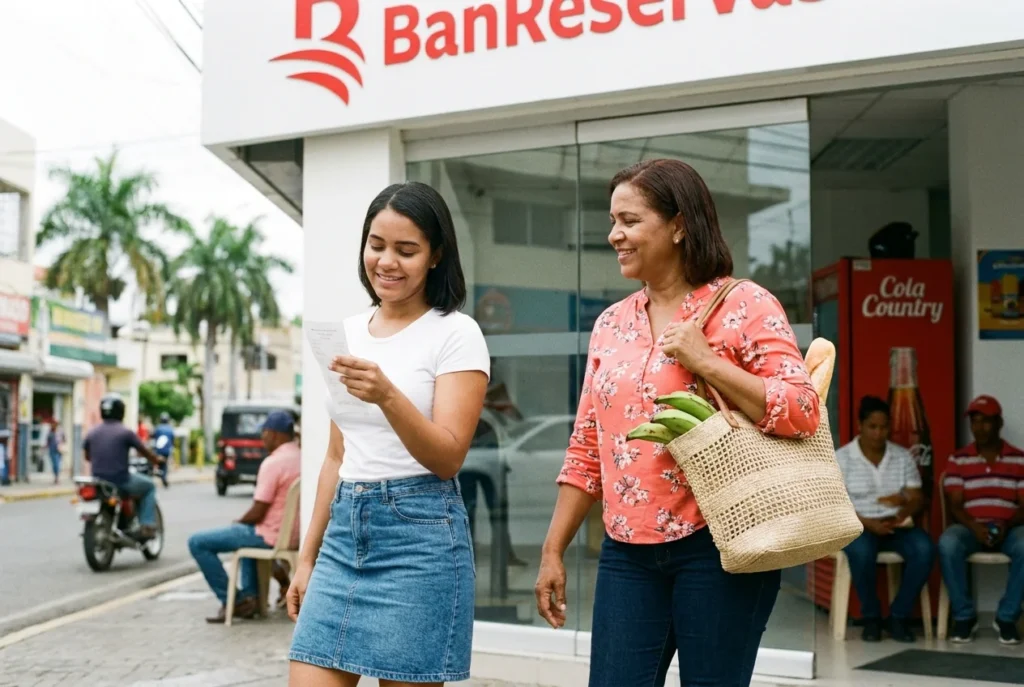
That is the part most providers will not tell you, because they cannot. They are international apps with no relationship to what the bank means to the people who use it. When you send money to BanReservas from the USA, you are sending it to the bank your family already trusts, often the only one they have ever trusted. Your tía does not have to learn anything new. She walks into the same sucursal she has walked into for twenty years and her money is already there. To understand the deeper meaning behind these transfers, beyond the mechanics of bank accounts, see our piece on what Dominican diaspora remittances really mean for the families who depend on them.
How Fast Will the Money Arrive?
Most ShareMoney bank deposits to the Dominican Republic complete in as few as 15 minutes. Once the deposit clears, the funds are immediately available for your family to withdraw at any BanReservas branch, ATM, or via the BanReservas mobile app.
The exact timing depends on the time of day you send and the payment method you use. Debit cards and ACH bank transfers tend to clear faster than credit cards. If you send during business hours from a US debit card, your relative usually has the money before they finish lunch.
No Hidden Fees and a Fair Exchange Rate
This is the part competitors hide and the part Dominican families ask about most. With ShareMoney, the exchange rate from US dollars to Dominican pesos and the transfer fee are both shown upfront, in the app, before you confirm. The amount your family receives is the amount you saw on screen.
There is one more important detail in 2026. The new US federal excise tax of 1% on remittances applies only to transfers paid with cash, check, or money order. Digital transfers paid with debit card, credit card, ACH bank transfer, or prepaid card are exempt. Because ShareMoney is a 100% digital service, your transfers do not pay this tax. On a $500 monthly remittance, that is $5 every month and $60 every year that stays with your family instead of going to the IRS.
If you want to understand exactly how the rate is calculated and how to make sure you are not losing pesos to a hidden margin, our cluster article on the USD to DOP exchange rate breaks it down step by step.
Bank Deposit or Cash Pickup: Which One Should You Choose?
ShareMoney supports both bank deposit and cash pickup for the Dominican Republic, but BanReservas itself is part of the bank deposit network. If your family has a BanReservas account, the cleanest path is direct deposit. Funds land in their account in minutes, they can withdraw at any of the more than three hundred BanReservas sucursales nationwide, and there is no need for them to go anywhere with an ID and a reference number.
If your family does not have a BanReservas account yet, you have two options. The first is to send the money to a cash pickup network instead. The Dominican cash pickup partner most families know is Caribe Express, with a presence in colmados, supermarkets, and small commerce in nearly every barrio. We covered that flow in detail in our guide on how to send money to Caribe Express from the USA.
The second option is for your relative to open a BanReservas cuenta de ahorros. The process is straightforward and free. They need their cédula, proof of address, and they can do it at any BanReservas branch in under thirty minutes. Once the account is open, every transfer you send afterwards arrives directly, no trip to a colmado required.
Beyond BanReservas, you can send a transfer to the Dominican Republic to any major bank, cash pickup point, or home delivery with ShareMoney.
Cuenta de Ahorros or Cuenta Corriente: What You Need to Know
Most Dominican families have a cuenta de ahorros (savings account), not a cuenta corriente (checking account). For receiving remittances from the USA, both work identically. The transfer arrives the same way. Your family can withdraw the same way. The fees on the receiving side are the same.
The practical difference matters only if your relative writes checks or runs a small business through the account. Cuentas corrientes are designed for higher transaction volume. Cuentas de ahorros are designed to hold money and earn a small interest. For a family member receiving a monthly remittance to cover rent, school, food, or medical expenses, a cuenta de ahorros is the standard choice.
When you fill in the recipient information on the ShareMoney app, the bank account number is what matters, not the account type. Both are 10 to 13 digits long and look the same.
Frequently Asked Questions
Can I send money to BanReservas if I do not have a US bank account?
Yes. ShareMoney accepts debit cards, credit cards, and most prepaid cards. You do not need a US bank account to send money to BanReservas from the USA.
What information do I need from my family to send money to their BanReservas account?
You need their full legal name as it appears on their cédula and their BanReservas account number. That is it. You do not need their cédula number or address.
Is there a maximum I can send to BanReservas in one transfer?
The standard ShareMoney limit is up to $2,999 every 24 hours and up to $9,999 every 180 days. These limits are set by US compliance rules, not by BanReservas.
Will my family pay any fee on the receiving side?
No. BanReservas does not charge a fee to receive a deposit through ShareMoney’s network. The only cost is the small transfer fee on the US side, which you see before you confirm.
Does ShareMoney work with other Dominican banks too?
Yes. ShareMoney supports BanReservas, Banco Popular Dominicano, BHD León, Scotiabank RD, Banco Caribe, Banco Santa Cruz, and several smaller banks. The flow is the same. You select the recipient’s bank from the list and enter their account number.
Get the real BanReservas transfer with ShareMoney
What does not change is what your family needs. Rent next week. The colmado bill. School fees for your hijo. The medical appointment your madre keeps postponing. What ShareMoney makes sure of is that every dollar you send lands in her BanReservas account in minutes, at the exchange rate you saw on screen, with no surprise fees on top. Your first three transfers are free of the ShareMoney fee, up to $500 each with a US debit card. After that, the cost is small and visible before you confirm. Download the app and send your first transfer now.
Related reading: Send Money to the Dominican Republic from the USA: Best 2026 Guide · Caribe Express Dominican Republic: How to Send Money from the USA