

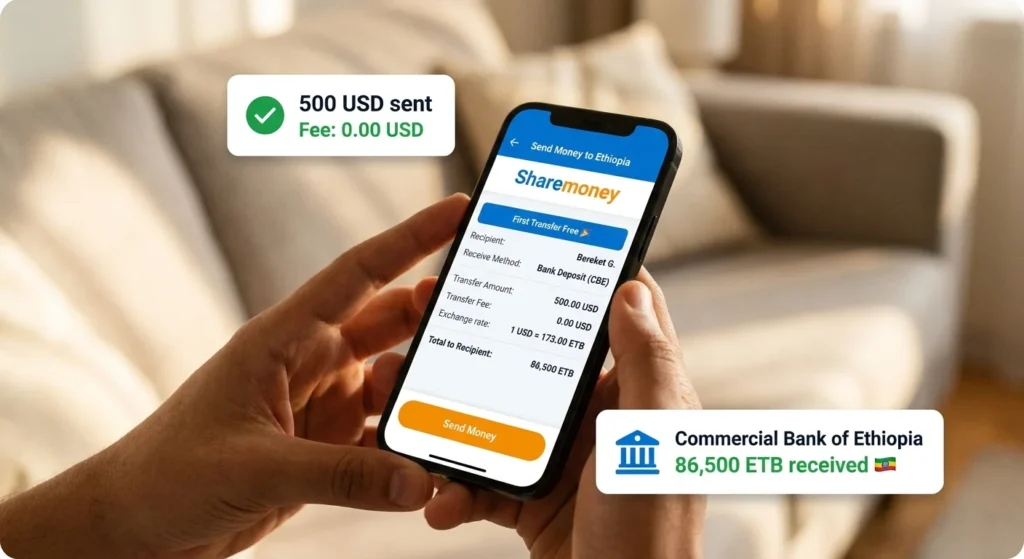
The cheapest way to send money to Ethiopia from the USA in 2026 is through a digital app like ShareMoney with direct bank deposit. The first transfer is free up to $500 USD with a debit card, the Birr settles at the official National Bank of Ethiopia rate, and digital transfers are exempt from the new 1% federal excise tax that cash agents now have to charge. Here is how the real costs break down.
The Cheapest Way to Send Money to Ethiopia in 5 Steps
- Download the ShareMoney app from the App Store or Google Play, and create an account with your US phone number.
- Verify your identity with a valid US passport, driver’s license, or state ID. This is a one-time KYC step.
- Add a debit card as your payment method. Debit is the cheapest funding option and unlocks the free first transfer; credit card and ACH bank transfer also stay exempt from the 1% federal tax.
- Enter your family member’s Commercial Bank of Ethiopia (CBE) account, or their telebirr wallet number, plus the amount you want to send.
- Compare the live USD to ETB rate and the total Birr your family receives, confirm the fee shows $0.00 on your first transfer, and tap Send. The deposit lands in minutes.
That is the whole flow. The cheapest path is debit-funded, deposited directly to a bank account, at the official rate, with no agent counter and no federal tax.
What Actually Makes a Transfer Cheap: The Three Hidden Costs
When you compare the cheapest way to send money to Ethiopia, the sticker fee is only one of three costs. Most families focus on the upfront fee and miss the two that quietly cost more over a year of monthly transfers.
The transfer fee. This is the number every service shows you upfront. ShareMoney waives it entirely on the first transfer up to $500 with a debit card, and keeps it low afterward. Some competitors advertise “zero fee” while quietly recovering the cost in the exchange rate.
The exchange rate margin. This is the hidden cost most families never calculate. Every service adds a markup on top of the official National Bank of Ethiopia rate. According to World Bank Remittance Prices Worldwide, this margin runs anywhere from 2% to 6% on the Ethiopia corridor depending on the provider, and it is often larger than the fee itself. On a $500 transfer, a 4% rate margin costs $20, far more than a typical $4 fee.
The cheapest way to send money to Ethiopia is the one with the smallest spread above the official rate, not the one with the flashiest “zero fee” banner.
The 1% federal excise tax. New in January 2026, this is a cost that applies only to cash transfers through physical agents. We cover it in detail below, but the short version: pay digitally and you skip it entirely.
Cost Comparison: Digital Delivery vs Cash Agent vs Hawala
The table below compares the three paths Ethiopian families actually use, on the three costs that matter. All figures are illustrative for a $500 monthly transfer.
| Method | Typical fee | 1% excise tax | Rate type |
|---|---|---|---|
| ShareMoney telebirr wallet (debit) | $0 first transfer, low after | No, digital exempt | Official NBE rate, narrow margin |
| ShareMoney bank deposit to CBE (debit) | $0 first transfer, low after | No, digital exempt | Official NBE rate, narrow margin |
| Western Union or MoneyGram cash agent | $8 to $15 | Yes, +$5 on $500 | Official rate + agent margin |
| Hawala (informal channel) | Low or hidden | Not applicable, unregulated | Parallel rate, no legal protection |
The math over a year of $500 monthly transfers is where the difference shows. A cash agent charging a $10 fee plus the $5 federal tax costs about $180 a year before the rate margin. A digital bank deposit with a waived first transfer and a narrow rate margin costs a fraction of that.
The cheapest way to send money to Ethiopia is rarely the most visible option at the strip-mall counter; it is the digital one that skips both the agent fee and the federal tax. Our guide to getting the best exchange rate when sending money from the USA breaks down how to compare the rate margin between providers.
A word on hawala. The informal system shows a higher Birr number on paper because it uses the parallel market rate, and it can look like the cheapest way to send money to Ethiopia. The cost is real but hidden: hawala is unregulated, untraceable, and outside the protection of US and Ethiopian financial law. If a transfer goes wrong, there is no recourse. A licensed digital bank deposit trades a slightly lower paper rate for legal traceability and an SMS confirmation.
The 1% Federal Excise Tax: The New Cost Cash Senders Pay
In January 2026, the United States introduced a 1% federal excise tax on international remittances. The text of the tax law is published by the IRS. For families comparing the cheapest way to send money to Ethiopia, this tax is now a deciding factor.
If you walk into a Western Union or MoneyGram counter and pay in cash, check, or money order, the 1% applies to every transfer. On $500, that is $5 extra. Over twelve months of monthly transfers, that is $60 a year in federal tax alone, on top of the agent fee and the rate margin.
If you pay digitally with a debit card, credit card, or ACH bank transfer, the 1% does not apply. The exemption is built into the law, not a promotion. ShareMoney processes 100% of its transfers digitally, so every transfer through the app is automatically exempt. For families who send every month, choosing digital is no longer just about convenience; it is the single clearest way to cut a recurring cost. For more on debit-funded transfers, see our guide on how to transfer money to a debit card.
Why the Exchange Rate Is the Biggest Hidden Cost
The Ethiopian Birr rate is the cost most families underestimate. The National Bank of Ethiopia sets the official rate, which has been managed-floating since August 2024 under an IMF reform program. It moved from a fixed level near 57 ETB per USD before the float and continues to adjust.
Two rates exist side by side: the official rate that licensed banks settle at, and a parallel rate higher than the official one, available only through informal channels. When a service quotes you a Birr amount, the real question for finding the cheapest way to send money to Ethiopia is not “what is the parallel rate?” but “how close to the official rate is this provider settling?” A narrow margin above the official rate beats a flashy “zero fee” banner that hides a wide spread.
ShareMoney’s margin stays close to the bank standard, which is why the first transfer can be free and ongoing transfers still beat the cash-agent total. The full corridor picture is in our complete guide to sending money to Ethiopia from the USA.
Why Cost Matters to Habesha Families
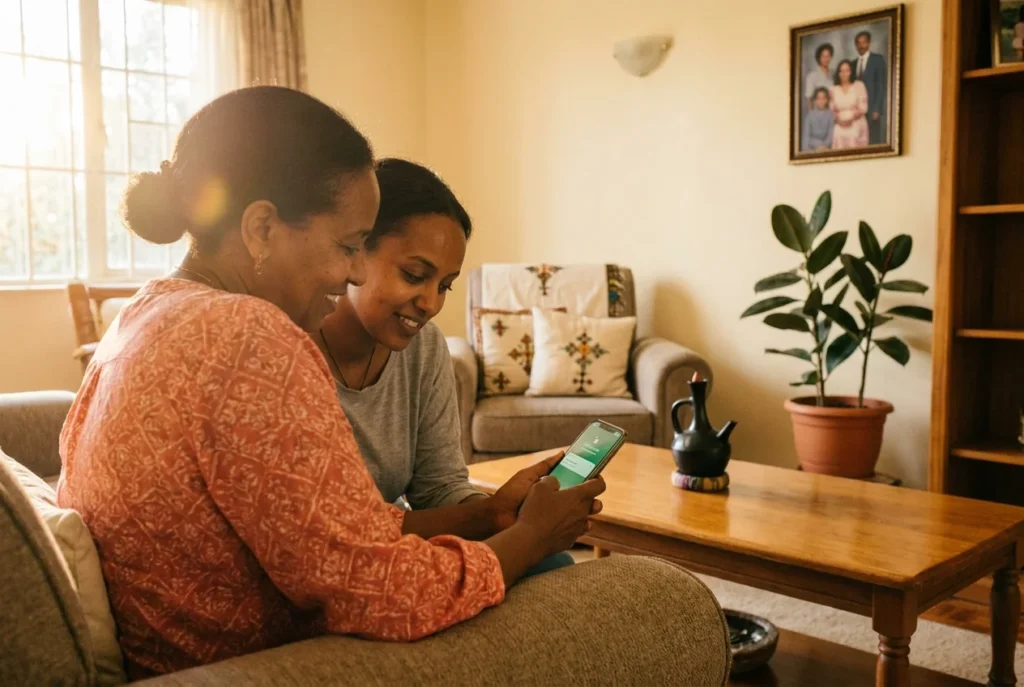
For Ethiopian families who send $300 to $500 every month, a few dollars of difference per transfer adds up to real money over a year. The diaspora in the United States is among the largest outside the African continent, concentrated in the Washington DC metro (more than 80,000 in Silver Spring, Alexandria, and Northern Virginia), Minneapolis-Saint Paul, Atlanta, Seattle, and Los Angeles. These are working families: rideshare drivers, hospital staff, restaurant cooks, salon owners, parents sending to Addis Ababa, Bahir Dar, Mekelle, and Hawassa.
The rhythm of sending peaks around the Ethiopian calendar. Fasika, the Orthodox Easter, is the year’s largest remittance moment, when families send more to cover the feast, new clothes for children, and the cost of doro wat and injera. Enkutatash, the New Year on September 11, brings back-to-school spending. Meskel, Genna, and Timkat each carry their own pulse.
At these peaks, when a family might send $800 or $1,000 instead of the usual $400, the gap between the cheapest digital path and a cash agent with the new 1% tax is sharpest. A $1,000 cash transfer pays $10 in federal tax alone; the same transfer sent digitally pays nothing. Over a year of holidays and monthly support, choosing the cheapest way to send money to Ethiopia keeps more Birr in the hands of the family who needs it.
Frequently Asked Questions
What is the cheapest way to send money to Ethiopia from the USA?
The cheapest way is a digital transfer with direct bank deposit, funded by a debit card. With ShareMoney the first transfer is free up to $500 USD, the Birr settles at the official National Bank of Ethiopia rate with a narrow margin, and the transfer is exempt from the new 1% federal excise tax that applies to cash transfers. Compare the total Birr received, not just the upfront fee, because the exchange rate margin is often the larger cost.
Is it cheaper to send money to Ethiopia online or through a cash agent?
Online is almost always cheaper. A cash agent charges a transfer fee (typically $8 to $15), adds an exchange rate margin, and since January 2026 also charges the 1% federal excise tax on cash transfers. A digital bank deposit waives the first-transfer fee, keeps a narrow rate margin, and is exempt from the federal tax. Over a year of monthly transfers, the difference can be $100 or more.
Does the 1% federal excise tax make sending money to Ethiopia more expensive?
It depends on how you pay. The 1% federal excise tax that took effect January 2026 applies only to remittances paid in cash, check, or money order from the US side. Digital transfers paid by debit card, credit card, or ACH are exempt. Choosing a digital app like ShareMoney avoids the tax entirely.
How much does it cost to send $500 to Ethiopia?
With ShareMoney, the first transfer of up to $500 is free with a debit card, so the only cost is the exchange rate margin, which stays close to the official rate. A cash agent on the same $500 would typically charge an $8 to $15 fee plus the $5 federal excise tax, plus a wider rate margin, so the real cost is significantly higher.
What is the USD to Ethiopian Birr exchange rate, and why does it affect the cost?
The official rate, set by the National Bank of Ethiopia, has been managed-floating since August 2024 and keeps moving. The exchange rate matters because every provider adds a margin on top of it, and that margin is often a larger cost than the upfront fee. The cheapest provider is the one settling closest to the official rate.
Is the cheapest option also safe?
Yes, when it is a licensed service. ShareMoney is licensed in 49 US states under NMLS #899521 and settles through licensed Ethiopian banking partners, so the cheapest digital path is also fully traceable and protected. Informal channels like hawala may show a cheaper paper rate but carry no legal protection if a transfer goes wrong.
Send Money to Ethiopia the Cheapest Way with ShareMoney
The cheapest way to send money to Ethiopia from the USA adds up over a year of monthly transfers: a waived first-transfer fee, a narrow margin above the official Birr rate, and full exemption from the new 1% federal excise tax. ShareMoney deposits directly to your family’s bank account in minutes, with the first transfer free up to $500 with a debit card. No agent counter, no federal tax, no parallel-market risk.
Related reading: How to send money to Ethiopia from the USA: the full corridor guide · Send Money to CBE from the USA: Best 2026 Guide · Send Money to telebirr from the USA: Best 2026 Guide · Send money to Ethiopia: rates and delivery methods