
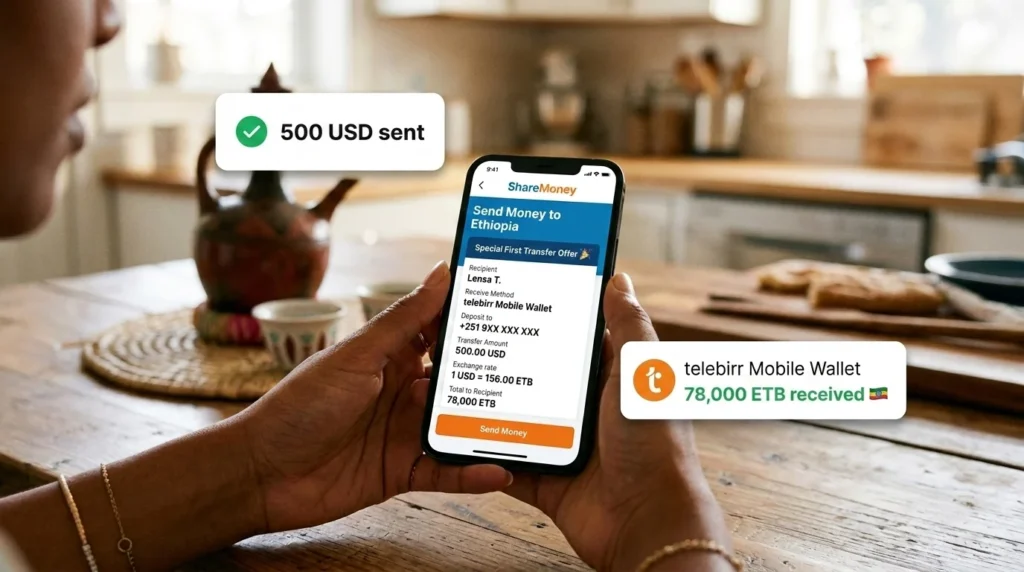
The fastest way to send money to telebirr from the USA in 2026 is via a digital app like ShareMoney. Your first transfer is free up to $500 USD with a debit card, the Birr lands in your family’s telebirr wallet within minutes on any phone, and the transfer is exempt from the new 1% federal excise tax that took effect January 2026 on cash remittances.
You can check the live birr rate and start your transfer on the ShareMoney Ethiopia mobile wallet page.
How to Send Money to telebirr from the USA in 5 Steps
- Download the ShareMoney app from the App Store or Google Play, and create an account with your US phone number.
- Verify your identity with a valid US passport, driver’s license, or state ID. This is a one-time KYC step for your first transfer.
- Add a payment method: a debit card (Visa, Mastercard, or Discover), a credit card, or your US bank account via ACH. Prepaid Visa cards work too.
- Enter the recipient details: your family member’s full name as it appears on their Ethiopian ID, and the phone number registered with their telebirr wallet. The number starts with +251 9 followed by eight digits.
- Confirm the live USD to ETB rate, review the total Birr your family will receive, and tap Send. The telebirr deposit usually lands in seconds and triggers an SMS plus an in-app notification on your family’s phone.
That is the entire flow. The first transfer is free up to $500 USD when paid with a debit card, and the rate ShareMoney shows is the rate that lands in your family’s telebirr balance.
What telebirr Is and Why It Matters for Ethiopian Families
telebirr is the mobile wallet operated by Ethio Telecom, the country’s national telecommunications company. It launched in May 2021 under a new National Bank of Ethiopia framework that opened mobile money to non-bank issuers, and within five years it has grown from a brand-new product into the most widely used digital payment platform in the country. According to Ethio Telecom’s 2025-26 first-half fiscal report, telebirr now serves over 58 million customers, with cumulative transactions exceeding 6.88 trillion Birr since launch. For most Ethiopian families with a smartphone, telebirr is the wallet they actually use.
When you send money to telebirr from the USA, three realities about the platform matter.
Phone is the account. A telebirr wallet is tied to a registered Ethiopian phone number, not to a bank account. Your family member does not need a bank account of any kind to receive your transfer. If they have a phone, an Ethiopian SIM, and a registered telebirr identity, they can receive Birr. This makes telebirr particularly useful for young family members, students, semi-urban relatives, and anyone in your family who simply prefers mobile money to a bank passbook.
The wallet types and what they mean for you. telebirr offers a Standard wallet that handles peer-to-peer transfers, bill payments, airtime top-ups, and merchant payments. There is also telebirr Mela, a credit and savings layer that holds micro-loans and interest-bearing balances. International remittances always land in the Standard wallet. From there, your family can keep the Birr in the wallet for everyday spending, send a portion to a telebirr Mela savings balance, withdraw cash at any telebirr agent, or transfer to a CBE or Awash account for larger expenses.
Interoperability with banks is built in. Once Birr is in a telebirr wallet, it does not stay locked there. Your family can transfer the balance to their Commercial Bank of Ethiopia account, to Dashen Bank, to Awash, or to Bank of Abyssinia, usually for free. They can also withdraw cash at a network of authorized telebirr agents in every region of Ethiopia, from Addis Ababa to Bahir Dar to Hawassa to Dire Dawa, and increasingly in smaller towns where banks have no branch presence.
telebirr vs CBE vs Cash: Methods Compared
When you send money to telebirr from the USA, you have several options across the corridor. Each one works, each has different speed and cost characteristics, and each has a different relationship with the new 1% federal excise tax. The table below compares the four common paths Ethiopian families use.
| Method | Speed | Subject to 1% excise tax | Best for |
|---|---|---|---|
| ShareMoney digital app to telebirr wallet | Seconds to minutes | No, digital exempt | Younger family, urban or semi-urban, smartphone first |
| ShareMoney digital app to CBE or other bank deposit | Minutes to a few hours | No, digital exempt | Family with an established bank account for rent and school fees |
| Western Union or MoneyGram cash agent | Same day | Yes, 1% applies | Senders with no card or US bank account |
| Hawala (informal channel) | Hours to one day | Not applicable, unregulated | Senders aware of the legal and traceability risks |
The practical takeaway for most families: when you send money to telebirr from the USA through a digital app, the Birr arrives in seconds, the rate is the official National Bank of Ethiopia rate, the first transfer is free, and the transfer stays exempt from the federal excise tax. The same app also supports CBE bank deposit when that fits your family better. If you need an in-depth look at the bank deposit path, our guide to sending money to CBE from the USA walks through that flow.
A quick note on hawala. The informal money transfer system has been used by Habesha communities for decades, especially before licensed digital options existed at scale. It shows a higher Birr number on paper than the official rate because it uses the parallel market. The trade-off is real, though: hawala transfers are unregulated, untraceable, and outside the protection of US and Ethiopian financial law. If something goes wrong, there is no recourse. A telebirr deposit through ShareMoney trades a slightly lower paper rate for full legal traceability, an SMS confirmation, and a transaction ID that lives in the regulated banking system.
USD to ETB Rate When You Send to a telebirr Wallet
The official Ethiopian Birr rate, which is the rate telebirr settles incoming international remittances at, is set by the National Bank of Ethiopia. Since the central bank moved the Birr to a managed float in August 2024 under an IMF reform program, the rate has continued to adjust. ShareMoney shows the live figure before you confirm a transfer. telebirr credits all incoming foreign remittances at this official rate, regardless of which licensed service you use.
This matters when you compare a telebirr deposit to other methods. Some informal services advertise a parallel rate higher than the official rate, but that rate is not what gets credited to a real telebirr wallet through licensed channels. When you send through ShareMoney, the Birr that lands on your sister’s phone is calculated at the National Bank rate, the same rate she would see if she walked into a CBE branch and asked. That predictability matters when families budget for monthly rent, school fees, transport, or medical costs, all of which are paid in Birr.
For senders comparing rates across digital providers, the relevant question is not “what is the parallel rate today?” but “what is the spread above the official rate?” Different licensed apps add different margins on top of the National Bank reference. ShareMoney’s margin stays close to the bank standard, which is why the first transfer can be free, and why ongoing transfers usually beat the cash-agent alternative even on the same Birr deposit. Our guide to getting the best exchange rate when sending money from the USA goes deeper on how margins work and how to compare them.
According to World Bank Remittance Prices Worldwide, Ethiopia remains one of the corridors where digital methods consistently undercut cash agents, and the gap is widening since the 1% federal tax began applying to cash remittances in January 2026. The cost advantage of digital is no longer a marketing claim; it is structural in the cost stack.
Why telebirr Matters to the Habesha Diaspora

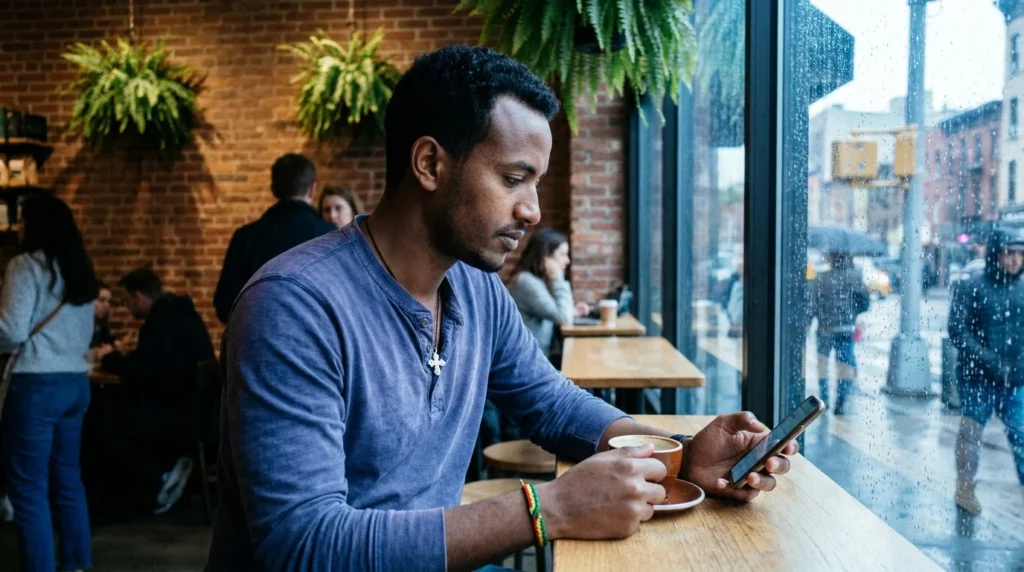
For the younger half of the Habesha diaspora in the United States, telebirr is the wallet that finally feels familiar. Your cousin in Addis pays for a Bolt ride with it, the small grocery on the corner of his neighborhood accepts it, his university tuition installments can be paid through it, and his mother now reluctantly trusts it after using it for three years. When you send money to telebirr from the USA, the Birr lands where your family already lives digitally. There is no extra step, no agent counter to visit, no passbook to update.
This generational fit matters in practice. The diaspora’s largest cohort sending today is the 25-to-40 age range: rideshare drivers, hospital staff, restaurant cooks, salon owners, software developers, parents of young US-born children. They communicate with family back home on WhatsApp, on Telegram groups, on Instagram. A telebirr deposit fits naturally into that rhythm. The notification arrives on the same phone where the family video calls happen. The transaction is part of a conversation, not a separate errand.
The Ethiopian calendar still shapes the rhythm of sending. Fasika, the Orthodox Easter, remains the year’s largest remittance moment for Habesha families, and telebirr volumes peak in the three weeks leading to the feast. Enkutatash, the Ethiopian New Year on September 11, brings the back-to-school spending: tuition, uniforms, books, contributions toward neighborhood iqub commitments. Meskel in late September, Genna on January 7, Timkat on January 19, and for many families also Eid al-Fitr and Eid al-Adha each carry their own remittance pulse. telebirr captures most of those small, frequent sends because the friction is nearly zero on the receiving side.
The Ethiopian-born population in the United States, estimated by the US Census Bureau American Community Survey at over 325,000, is concentrated in the Washington DC metro (more than 80,000 in Silver Spring, Alexandria, and Northern Virginia), Minneapolis-Saint Paul (about 45,000), Atlanta (35,000), Seattle (25,000), and Los Angeles (20,000). These are working communities. The average sender moves $300 to $500 monthly to family in Addis, in the Amhara and Oromia countryside, in Mekelle, in Dire Dawa, in Hawassa. The corridor total to Ethiopia from the USA was an estimated $2.4 billion in 2024 according to the World Bank, and the share moving through mobile wallets like telebirr keeps growing each quarter.
ShareMoney supports the telebirr corridor directly because that is where the next generation of families banks. The app does not redirect you to a different wallet or a competing service. It deposits to telebirr and to CBE, at the official rate, in minutes. The choice of where the Birr lands stays with the family, not with the sender’s app.
When telebirr May Not Be Your Best Fit
telebirr is the right choice for most digital-first Ethiopian families. It is not the right choice for every situation, and we want to be honest about the exceptions.
If your family lives in a deeply rural area without consistent mobile network coverage, a telebirr deposit can still arrive but cashing it out may require travel to the nearest agent or bank branch. A CBE branch deposit may be more practical in those cases, and ShareMoney supports it. For a deeper look at debit-card-funded transfers and how they compare to other payment options on the US side, see our guide on how to transfer money to a debit card.
If your family member does not have a registered telebirr identity, the deposit cannot complete. Registration requires an Ethiopian phone number and an Ethiopian Fayda or kebele ID. A short visit to any Ethio Telecom branch or authorized agent handles the registration in minutes. After that, your future transfers run end to end on the phone.
If you are sending a large monthly amount destined entirely for rent and school fees that the family pays directly to a bank, depositing to their CBE account avoids an extra internal transfer. telebirr is excellent for everyday expenses and smaller transactions; bank deposit fits better for large recurring obligations.
If your family uses a different mobile wallet, such as the CBE Birr wallet integrated with CBE accounts, or a sub-wallet inside another bank’s app, ShareMoney supports the main bank account underlying that wallet. The family can move the Birr internally to whichever sub-wallet they prefer.
Most families end up with a combination: telebirr for daily spending and small frequent sends, and a CBE account for larger monthly transfers. Sending to either or both is supported.
Frequently Asked Questions
Does my family need a smartphone to receive money sent to telebirr from the USA?
A smartphone helps but is not required. telebirr works on feature phones through USSD codes (*127# in Ethiopia) for balance checks, cash-out at agents, and small transfers. A smartphone gives access to the full telebirr app with notifications, transaction history, and merchant payments. The deposit arrives the same way on either device.
What phone number format do I need to send money to telebirr from the USA?
You need your family member’s Ethiopian phone number registered with telebirr, in international format. It starts with the country code +251, then 9, then eight digits. For example, +251 9XX XXX XXX. Confirm the exact number with your family before your first transfer, because telebirr deposits are tied to that specific registered number.
How long does it take for a remittance to land in a telebirr wallet?
ShareMoney transfers to telebirr typically arrive within seconds and almost always within a few minutes. Your family receives an SMS from telebirr plus an in-app notification once the deposit is credited. Same-day delivery is the standard, and most transfers feel near-instant.
Are remittances to telebirr wallets subject to the new 1% federal excise tax?
The 1% federal excise tax that took effect in January 2026 applies to international remittances paid in cash, check, or money order from the US side. The text of the tax law is published by the IRS. Digital transfers paid by debit card, credit card, or ACH bank transfer, including remittances sent through ShareMoney to telebirr, are exempt. The exemption is structural, not promotional.
Can my family cash out the telebirr balance at a bank or agent?
Yes. Your family can withdraw cash at any authorized telebirr agent in Ethiopia, transfer the Birr to a CBE, Dashen, Awash, or other bank account for free, or use the balance directly for merchant payments, bill payments, and airtime. Cash-out at agents requires the recipient’s ID and the transaction code from the SMS.
Is ShareMoney licensed to send money to telebirr wallets from the United States?
Yes. ShareMoney is licensed in 49 US states under NMLS #899521. Transfers to telebirr settle through licensed Ethiopian remittance and banking partners, which means the Birr lands in your family’s regulated telebirr wallet through the official banking system, not through informal channels. Every transfer is traceable, includes an SMS confirmation, and is protected under both US and Ethiopian financial law.
Get the real telebirr deposit with ShareMoney
When you send money to telebirr from the USA, the wallet your family already uses, the rate that settles, and the tax exemption all add up over a year of monthly transfers. ShareMoney deposits to your family’s telebirr wallet in seconds, at the official Birr rate, with the first transfer free up to $500 with a debit card. No agent counter, no 1% excise tax, no parallel-market risk. The Birr lands on the same phone where the family conversation already lives.
Related reading: How to send money to Ethiopia from the USA: the full corridor guide · Send Money to CBE from the USA: Best 2026 Guide · Send money to Ethiopia: rates and delivery methods