

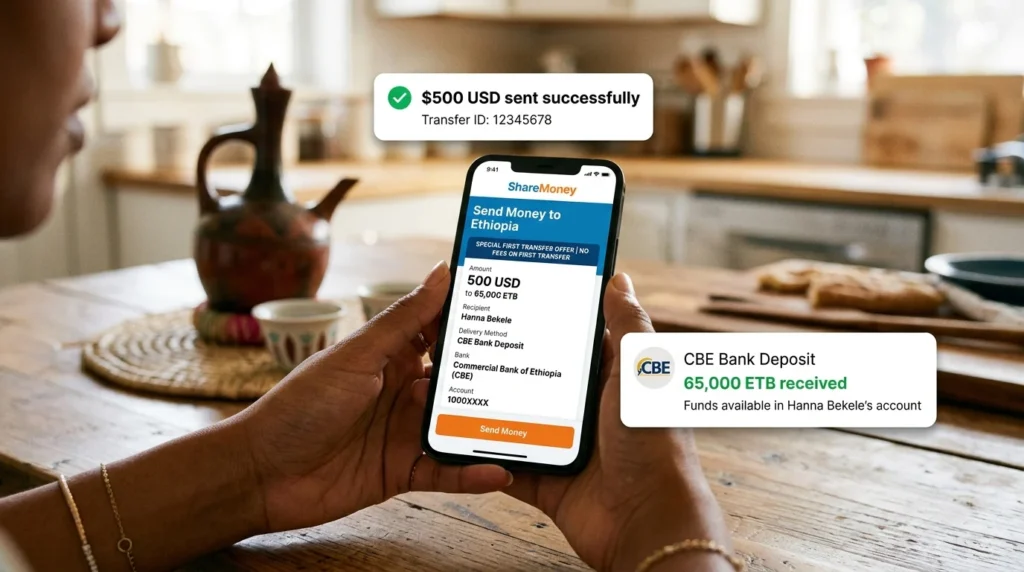
The fastest way to send money to CBE from the USA in 2026 is via a digital app like ShareMoney. Your first transfer is free up to $500 USD with a debit card, the Birr is deposited directly into your family’s Commercial Bank of Ethiopia account, and the transfer is exempt from the new 1% federal excise tax that took effect January 2026 on cash remittances.
How to Send Money to CBE from the USA in 5 Steps
- Download the ShareMoney app from the App Store or Google Play, and create an account with your US phone number.
- Verify your identity with a valid US passport, driver’s license, or state ID. This is a one-time step for first-transfer KYC.
- Add a payment method: a debit card (Visa, Mastercard, or Discover), a credit card, or your US bank account via ACH. Prepaid Visa cards work too.
- Enter the recipient details: your family member’s full name as it appears on their ID and their Commercial Bank of Ethiopia account number. CBE account numbers are 13 digits and start with “1000”.
- Confirm the live USD to ETB rate, review the total Birr your family will receive, and tap Send. CBE deposits arrive in minutes during business hours and within a few hours otherwise.
That is the entire flow. The first transfer is free up to $500 USD when paid with a debit card, and the rate ShareMoney shows is the rate that lands in your family’s CBE account.
What CBE Offers Diaspora Senders
The Commercial Bank of Ethiopia, founded in 1942, is the country’s largest financial institution. According to CBE’s own corporate data, it operates more than 1,950 branches nationwide, serves over 45 million account holders, and holds roughly two-thirds of all bank deposits in Ethiopia. For most Ethiopian families, CBE is the bank. It is the institution where children are taken at age 16 to open their first account, where elders maintain decades-long passbook records, and where diaspora remittances land most predictably.
For senders in the United States, three CBE realities matter when you send money to CBE from the USA.
Branch density. With nearly 2,000 branches, CBE has the deepest physical reach in Ethiopia of any single bank. From the central piazza in Addis to towns the size of Hawassa, Bahir Dar, and Mekelle, your family can usually access a CBE counter within reasonable walking distance. For families in rural Oromia, Amhara, or the SNNPR, CBE often is the only bank in town.
Mobile and ATM access. CBE offers the CBE Mobile Banking app on iOS and Android, the CBE Birr digital wallet for everyday merchant payments, USSD codes for feature phones, and a network of over 1,200 ATMs concentrated in Addis Ababa and regional capitals. Once funds land in a CBE account, your family can withdraw cash at any ATM or pay merchants via QR code without visiting a branch.
Foreign currency accounts. CBE offers Foreign Currency Accounts (FCAs) in USD and EUR for diaspora customers, designed specifically to receive international remittances and preserve their value against Birr inflation. While most family senders use a regular Birr account for monthly remittances, the FCA is worth knowing about if your family is saving for a large purchase (home, vehicle, education) and wants to hold dollars instead of Birr. CBE has also announced plans to open international branches in Washington DC, Djibouti, and Dubai, signaling the bank’s continued investment in the diaspora corridor.
CBE vs Other Methods: Speed, Fees, and the 1% Tax Compared
When you send money to CBE from the USA, you have several options. Each works, each has different speed and cost characteristics, and each has a different relationship with the new 1% federal excise tax. The table below compares the four most common paths.
The practical takeaway for most families: a digital app that deposits directly to CBE in minutes, settles at the official Birr rate, charges low or zero fees on the first transfer, and stays exempt from the excise tax. That is the path ShareMoney occupies in the corridor.
A quick note on hawala. The parallel money transfer system has been used by Habesha communities for decades, especially before licensed digital options were available. It moves money quickly and shows a higher Birr number on paper than the official rate. The cost is real, though: hawala transfers are unregulated, untraceable, and outside the protection of US and Ethiopian financial law. If something goes wrong, there is no recourse. CBE bank deposits via ShareMoney trade a slightly lower paper rate for full legal traceability and protection.
USD to ETB Rate When You Send to a CBE Account
The official Ethiopian Birr rate, which is the rate CBE uses on all incoming international transfers, is set by the National Bank of Ethiopia. Since August 2024, this rate has been managed-floating under the IMF reform program, moving from a fixed level near 57 ETB per USD before the float and adjusting gradually since. CBE settles all incoming foreign remittances at this official rate, regardless of which licensed service you use to send.
This matters when you compare CBE bank deposit to other methods. Some informal services advertise a parallel rate higher than the official rate, but that rate is not what gets deposited into a real CBE account. If you send through ShareMoney, the Birr that lands in your mother’s CBE passbook is calculated at the National Bank rate, the same rate she would see if she walked into a CBE branch and asked. That predictability matters when families budget for monthly rent, school fees, or medical costs, all of which are paid in Birr through formal channels.
For senders comparing rates across digital providers, the relevant question is not “what is the parallel rate today?” but “what is the spread above the official rate?” Different licensed apps add different margins on top of the National Bank reference rate. ShareMoney’s margin stays close to the bank standard, which is why the first transfer can be free, and why ongoing transfers usually beat the cash-agent alternative even on the same Birr deposit. Our guide to getting the best exchange rate when sending money from the USA goes deeper on how margins work and how to compare them.
According to World Bank Remittance Prices Worldwide, Ethiopia remains one of the corridors with the largest gap between official and parallel rates globally, though the gap has narrowed since the float. The corridor cost average for a $200 transfer to Ethiopia was 5.8 percent in Q4 2024 and trending below 5.5 percent through 2025 for digital methods specifically. Cash methods remain expensive both because of the agent margin and now because of the new federal tax.
Why CBE Matters to Habesha Families
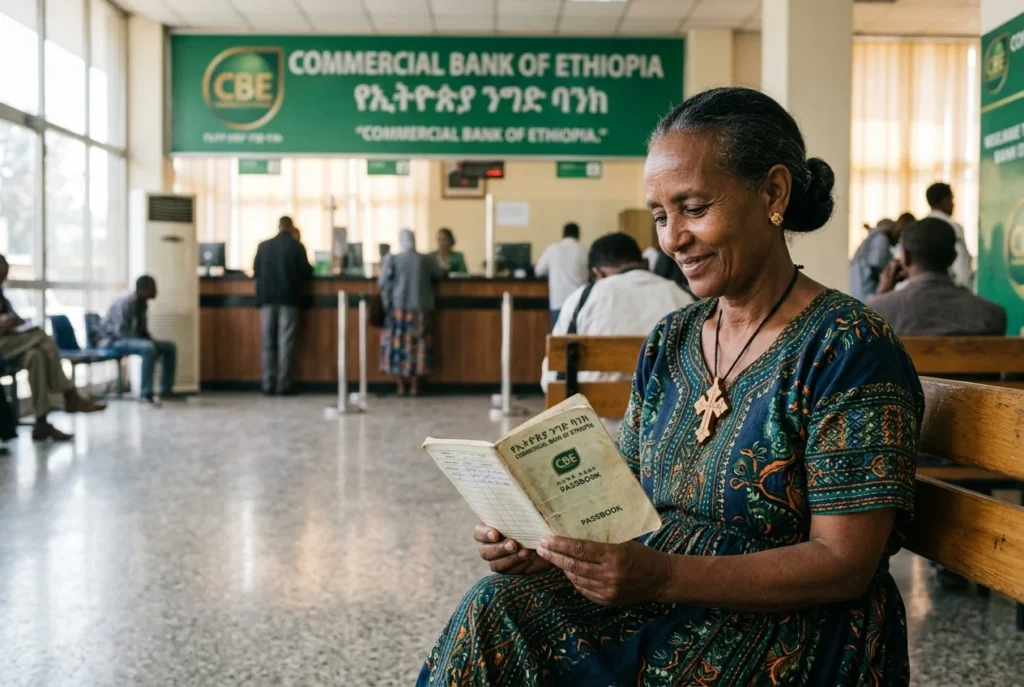
For most Habesha families, CBE is not just a bank. It is the bank. The institution carries the weight of three generations of family accounts, of children opening their first wegegeta at age 16, of elders maintaining handwritten passbooks updated at the same branch for decades. Sending remittance to a CBE account is also sending to a place with continuity. The same teller who served a grandmother in Bole in 2005 may still be there in 2026.
This continuity has practical value when you send money to CBE from the USA. A family member who picks up Birr at a CBE branch in Hawassa or Bahir Dar moves through a process they already know, with paperwork they have signed dozens of times, in a building they have visited since childhood. There is no app to learn, no agent code to remember, no foreign system to navigate. The remittance becomes part of the rhythm of life rather than a separate transaction.
The Ethiopian calendar shapes the rhythm of sending. Fasika, the Orthodox Easter, is the year’s largest remittance moment for Habesha families. Sending volumes peak in the three weeks leading to Fasika as families prepare for the feast, buy new clothes for children, and contribute to the cost of doro wat and injera that will feed extended family gatherings. Enkutatash, the Ethiopian New Year on September 11, brings the back-to-school spending: tuition, uniforms, books, and the small contributions toward neighborhood iqub (rotating savings) commitments. Meskel in late September, Genna on January 7, and Timkat on January 19 each carry their own remittance pulse.
The Ethiopian-born population in the United States, estimated at over 325,000 by the most recent American Community Survey data, is concentrated in the Washington DC metro (more than 80,000 in Silver Spring, Alexandria, and Northern Virginia), Minneapolis-St. Paul (about 45,000), Atlanta (35,000), Seattle (25,000), and Los Angeles (20,000). These are working communities: parking attendants, rideshare drivers, hospital staff, salon owners, restaurant cooks, school teachers. The average sender moves $300 to $500 monthly to family in Addis, in the Amhara and Oromia countryside, in Mekelle, in Dire Dawa, in Hawassa. The corridor total to Ethiopia from the USA was an estimated $2.4 billion in 2024 according to the World Bank, with the digital share growing each quarter.
ShareMoney supports the CBE corridor directly because that is where most of those families bank. The app does not try to redirect senders to a competing service. It deposits to CBE in Birr, at the official rate, in minutes. The choice of which bank to use stays with the family, not with the sender’s app.
When CBE May Not Be Your Best Fit
CBE is the right choice for most Ethiopian families. It is not the right choice for every situation, and we want to be honest about the exceptions.
If your family lives far from any CBE branch and does not own a smartphone, accessing a deposited Birr balance becomes harder. The CBE ATM network is dense in Addis and regional capitals, but thinner in rural Oromia and the Somali region. In those cases, cash pickup through a Western Union or MoneyGram agent location may be more practical, even with the 1% tax cost as the tradeoff.
If your family already uses a different primary bank (Dashen, Awash, Bank of Abyssinia, Hibret Bank, or Cooperative Bank of Oromia), ShareMoney does not deposit to it directly today. Send to their CBE account, or to a telebirr wallet, and they can move the Birr to their own bank locally, usually for free.
If you are sending a large business payment to a USD-denominated Ethiopian account rather than a remittance to family, a SWIFT wire from your US bank may be more appropriate than a consumer remittance app. ShareMoney is built for diaspora remittance, not for B2B transfers above $10,000.
If your family does not yet have an Ethiopian bank account, opening one at any CBE or other supported bank branch is straightforward with an Ethiopian ID and is a one-time step. ShareMoney deposits to bank accounts only, so this is a prerequisite for the Ethiopia corridor. For senders weighing payment methods on the US side, our guide on sending money online using a debit card covers what to consider before choosing how to pay.
Frequently Asked Questions
Can I send money to a CBE account from the USA without my family having to visit a branch?
Yes. When you send money to CBE from the USA through ShareMoney, the Birr is credited directly to your family’s existing CBE account. They can check the balance via the CBE Mobile Banking app, withdraw cash at any CBE ATM, or pay merchants via QR code without visiting a branch.
What CBE account information do I need from my family to send the transfer?
You need your family member’s full name as it appears on their Ethiopian ID, and their 13-digit CBE bank account number. CBE account numbers typically start with “1000”. ShareMoney sends to the CBE bank account only, so make sure you use the bank account number and not any internal CBE Birr wallet identifier.
How long does it take for a remittance to reach a CBE account?
ShareMoney transfers to CBE typically arrive within minutes during Ethiopian banking hours and within a few hours outside those hours. Same-day delivery is the standard. The transfer is settled in Birr at the official National Bank of Ethiopia rate and credited to the account number you provided. Your family receives an SMS notification from CBE once the deposit is posted.
Are remittances to CBE accounts subject to the new 1% federal excise tax?
The 1% federal excise tax that took effect in January 2026 applies to international remittances paid in cash, check, or money order from the US side. The text of the tax law is published by the IRS. Digital transfers paid by debit card, credit card, or ACH bank transfer, including remittances sent through ShareMoney to CBE, are exempt. The exemption is structural, not promotional.
Can my family open a CBE Foreign Currency Account to receive my remittances in USD instead of Birr?
Yes. CBE offers Foreign Currency Accounts (FCAs) in USD and EUR, primarily for diaspora customers who want to preserve dollar value against Birr movement. Eligibility and documentation requirements vary, so your family should contact a CBE branch international banking desk directly. For most monthly family remittances, a regular Birr account is the simpler and more practical option.
Is ShareMoney licensed to send money to CBE accounts from the United States?
Yes. ShareMoney is licensed in 49 US states under NMLS #899521. Transfers settle through licensed Ethiopian banking partners, which means the funds land in your family’s CBE account through the regulated banking system, not through informal channels. Every transfer is traceable and protected under both US and Ethiopian financial law.
Get Your First CBE Transfer Free with ShareMoney
When you send money to CBE from the USA, the bank you trust, the rate that settles, and the tax exemption all add up over a year of monthly transfers. ShareMoney deposits to your family’s CBE account in minutes, at the official Birr rate, with the first transfer free up to $500 with a debit card. No agent counter, no 1% excise tax, no parallel-market risk. The Birr lands in the same passbook your family has held for generations.
Related reading: How to send money to Ethiopia from the USA: the full corridor guide · How to get the best exchange rate when sending money from the USA · Send Money to telebirr from the USA: Best 2026 Guide · Send money to Ethiopia: rates and delivery methods