

Every time a Dominican in the USA sends money home, the usd to dop exchange rate decides how much actually lands in the family’s hands. A 20-centavo swing per dollar sounds like nothing, until you send $500 and your mother ends up with 100 dominican pesos more or less than she expected. That is why it pays to understand where the number comes from and why the rate you see on Google is almost never the rate you get when you send a remittance. This guide walks through how to read the real rate, how to calculate the exact pesos that will arrive, and how to avoid apps that quietly eat into your transfer.
What is the USD to DOP exchange rate today?
As of April 21, 2026, the usd to dop exchange rate is hovering around 60.10 DOP per dollar, with a weekly range between 59.66 and 60.43. The six-month average going back to late 2025 was 62.65 pesos per dollar, so the Dominican peso has appreciated close to 4% against the dollar over that window. In March 2026 the rate even touched 58.78 on certain days.
In concrete terms: if you were sending $500 back in November 2025, your family was getting roughly 31,325 pesos. Today the same $500 converts to around 30,050 pesos. The dollar buys fewer pesos than a year ago, and a few different forces are behind the trend.
What moves the dollar today in the Dominican Republic
Nobody sets the usd to dop exchange rate. It moves every business day based on who is buying and selling dollars in the market, and right now a handful of forces are pulling on it in different directions.
The Banco Central de la República Dominicana manages monetary policy with an inflation target. When it keeps rates high, international capital flows in looking for yield, and the peso strengthens. Tourism is also at record levels, with Punta Cana and the rest of the country bringing in dollars every day of the year.
Remittances are the other big flow. Dominican families received roughly $11.19 billion in remittances during 2024, close to 9% of the country’s entire GDP. That volume of dollars entering the market every month adds pressure on the peso. Ironically, your own remittance is part of what keeps the peso from dropping back to the 62 or 63 range.
On the other side, decisions by the US Federal Reserve move the dollar globally. When the Fed cuts rates, the dollar tends to weaken against emerging markets like the DOP. When it raises them, the opposite.
Why the rate you see on Google is not what you get when you send
Here is the piece almost nobody explains to the community: the usd to dop exchange rate you see on Google, XE, or the news is the interbank rate or mid-market rate. That is the rate banks use to exchange dollars between themselves. It is not the rate you receive when you send money to your family.
According to World Bank data on remittance prices, remittance companies typically apply a markup of between 5% and 7% on top of that interbank rate. That margin is part of how they make money, on top of the transfer fee. Some companies declare it openly, others hide it behind “zero commission” banners that already baked the spread into the exchange rate. For a deeper breakdown of delivery methods, fees, and payers in the DR, see the complete guide to sending money to the Dominican Republic from the USA.
Real example as of April 21, 2026:
- Interbank rate (BCRD reference): 60.10 DOP/USD
- Typical remittance company rate with 5% markup: 57.10 DOP/USD
- Difference on a $500 transfer: 1,500 pesos less for your family
That is why it always pays to see the exchange rate the app will apply before you confirm. If the app does not show it clearly, that is already a red flag.
How to calculate how many Dominican pesos your family will receive
The formula is simple:
Pesos received = Dollars sent × Applied exchange rate
For a $500 USD transfer at today’s rate of 60.10 DOP/USD:
$500 × 60.10 = 30,050 DOP
Heads up: that calculation uses the pure interbank rate. If the company applies a 5% markup, the actual math looks like this:
$500 × 57.10 = 28,550 DOP
A 1,500 peso difference on a single transfer. Multiply that by 12 transfers a year and you are talking about more than 18,000 pesos a year that quietly disappear along the way.
How to see the USD to DOP exchange rate before sending with ShareMoney
ShareMoney shows the exact rate you will use on the same screen where you type the amount. What you see is what your family receives, no fine print, no surprises at confirmation. Here is how it works:
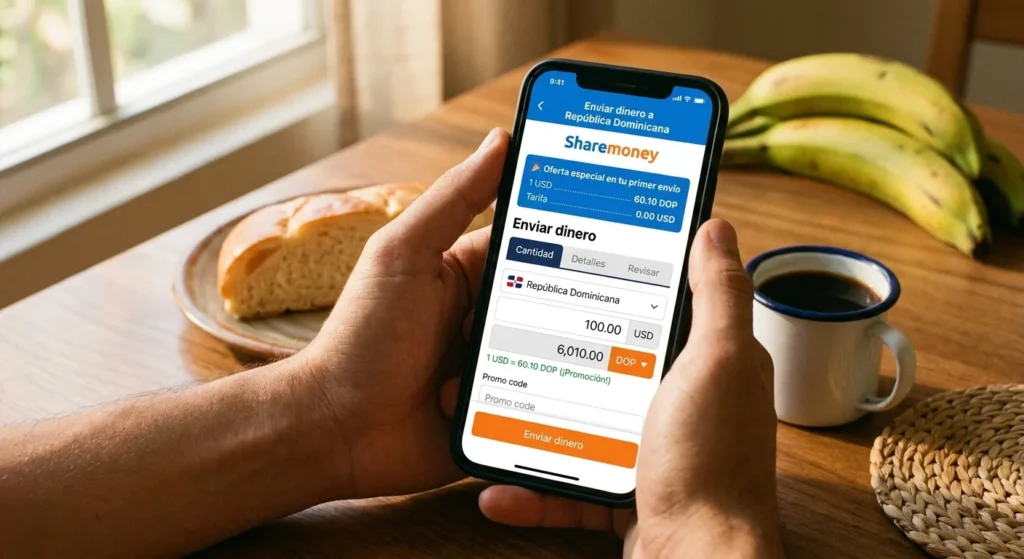
- Open the app and tap “Send to Dominican Republic.” The DR flag appears with the amount field in dollars.
- Type the amount in USD. The app calculates in real time the dominican pesos your family will receive, using ShareMoney’s current rate for that day.
- Look at the exchange rate line. It appears right under the dollar amount, in the format
1 USD = XX.XX DOP. That is the rate applied if you confirm in the next few minutes. - Choose a delivery method. Bank deposit to BanReservas, Banco Popular, BHD León, Scotiabank RD, or Banco Caribe, arriving in about 15 minutes. Cash pickup at 184 Caribe Express branches, Banco BHD locations, or Remesas Dominicanas. Or home delivery door-to-door in up to 6 hours.
- Confirm. Bank deposits clear in minutes. Cash pickup is ready almost immediately after you finish the transfer.
As noted on the official reference rate published by the Banco Central de la República Dominicana, the interbank rate is the public benchmark. Compare what any app offers against that rate and you will know in seconds if you are getting a fair deal.
Once you know the real rate, the rest is quick: you can send your remittance to the DR with ShareMoney and see the exact pesos your family receives on screen before you confirm.
5 tips to get more pesos out of every transfer
Compare the effective rate in pesos, not the commission in dollars. An app that promises “zero commission” can be charging you double hidden inside the usd to dop exchange rate. Always run the final math in pesos your family will actually receive.
Send when the dollar is stronger. Nobody predicts the market, but you can pay attention to weeks when the dollar climbs back above 61 or 62 pesos. Check the rate before any large transfer, especially before Christmas, Mother’s Day, or back-to-school season when demand peaks.
Split large transfers into two. If you plan to send $1,000 this month, consider sending $500 now and $500 in two weeks. You average the rate and reduce the risk of hitting a bad day.
Avoid credit cards. Many processors treat remittances as “cash advances” and charge high rates on top of everything else. Use a US bank account or a debit card directly through the app.
Use the first-transfer-free offer if you have not yet. New ShareMoney customers get the first transfer with no transfer fee, which means more pesos at the same exchange rate.
FAQ about the USD to DOP exchange rate
Is the rate the same all day?
No. The currency market moves in real time during business hours. The rate you see at 9 a.m. may be different by 3 p.m. Apps update their quote at regular intervals, usually every few minutes.
Why does my US bank give me a worse rate than ShareMoney?
Commercial banks typically apply higher markups than remittance-focused apps, plus they charge international transfer fees that can easily exceed $30 or $40 per wire. For family transfers, a remittance app is almost always cheaper.
What happens if the dollar goes up after I confirm my transfer?
The rate you confirm is locked in for that transfer. Your family receives the pesos calculated at the moment of confirmation, regardless of what happens in the market afterward.
Are there days I should avoid sending money to the Dominican Republic?
Weekends and Dominican bank holidays can have lower liquidity and sometimes worse rates. If the transfer is not urgent, Monday through Thursday tend to be the most efficient days.
Is the usd to dop exchange rate going to keep dropping?
Nobody has a crystal ball. Some analysts expect the peso to stay strong because of record tourism and remittance inflows; others see pressure from Fed rate decisions. What you do know is that every transfer uses the rate of the day. Do not wait for the dollar to “climb back” if your family needs the money now.
Get the real USD to DOP exchange rate with ShareMoney
The usd to dop exchange rate will change tomorrow, and the day after, and next week. What does not change is what that money means for your family back home: the light bill, the school uniform, mami’s medicine, the fiesta for your sister. Your job is to make sure as many of those dollars as possible arrive converted into real dominican pesos, not hidden margins. With ShareMoney you see the full rate before confirming, the exact pesos your family receives, and the deposit reaches BanReservas, Banco Popular, BHD León, or any Caribe Express branch in minutes.
Related reading: Money Transfer to the Dominican Republic from the USA: The Complete 2026 Guide · Caribe Express Dominican Republic: Your Step-by-Step Cash Pickup Guide